What a Truck Unloading Conveyor Does—and Why It Matters Now
A truck unloading conveyor is purpose-built to bridge the gap between a parked vehicle and the first processing point inside a facility. It reduces manual handling, compresses unloading cycles, and standardizes material flow. In fast-moving environments—express delivery hubs, cross-border logistics gateways, and high-velocity warehouses—this equipment has shifted from a “nice-to-have” to a baseline enabler of throughput and safety. As peak seasons and same-day expectations intensify, operations need predictable unloading speed at every dock door. A well-engineered solution provides that predictability, turning variable labor effort into steady, measurable performance.
Core designs typically include a powered belt or roller surface, adjustable boom sections, and mobility features (casters or rail guidance) that position the conveyor precisely into a trailer or container. Telescopic boom modules extend deep into 40-foot containers; height-adjust systems match dock level and the package stack; and guardrails keep parcels contained. Advanced units integrate photoelectric sensors, soft-start drives, and emergency-stop circuits to protect teams. By reducing high-frequency lifts, twists, and carries, a telescopic belt conveyor helps lower ergonomic risk and fatigue-related errors.
Measured by key dock metrics—unloads per hour, pieces per labor hour, and dock-to-stock time—a truck unloading conveyor consistently outperforms purely manual processes. Accelerating the first touch has ripple effects: upstream sorters receive steadier inflow, scanning stations avoid starve-block cycles, and putaway teams plan labor with fewer surprises. Damage rates also drop as packages experience fewer uncontrolled transitions and tosses. In industrial scenarios—bagged raw materials, drums, cartons—controlled flow keeps aisles clearer and handling equipment (forklifts, tuggers) on safer, more predictable routes.
Beyond speed and safety, modern designs support data-driven operations. Edge-mounted counters tally volume, condition monitoring tracks motor loads and bearing health, and PLC-connected controls sync with site-level systems. With accurate time stamps and piece counts, managers can compare shift performance, fine-tune labor allocation, and trigger replenishment earlier. This blend of mechanical reliability and digital visibility is central to resilient, scalable unloading—particularly for facilities coping with volatile demand or multi-origin inbound schedules.
Choosing the Right System: Telescopic, Flexible, and Hybrid Options
Selecting the best truck unloading conveyor hinges on product mix, trailer types, dock layout, and target throughput. For parcels and mixed cartons, powered telescopic belt conveyors remain the gold standard: they reach directly into vans, box trucks, and marine containers, delivering a smooth, controlled surface that reduces shingling and jams. Where loads vary in weight and packaging quality, a belt minimizes rattle and maintains consistent speed across long extensions. For tighter budgets or lighter volumes, gravity and motorized flexible conveyors offer agility: they snake from the dock head into the trailer, absorbing curves and tight turns around staging obstacles.
Roller versus belt is a key choice. Roller beds reduce friction and can be ideal for rigid cartons or totes with flat bottoms; belts handle softer packages, polybags, and irregular items better. Hybrid lines combine a powered telescopic boom at the trailer with flexible gravity sections downstream, creating a cost-effective flow path to scanning, weigh-dimensioning, or accumulation zones. Height-adjusting supports and lift-assist modules can further tune ergonomics for different operator statures and unload strategies (top-down vs. floor-stack-first).
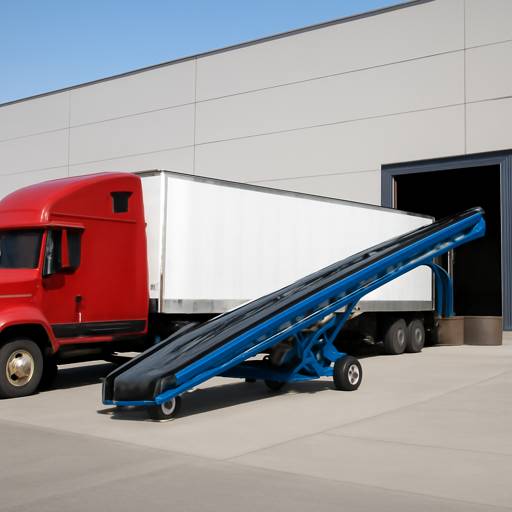
Environmental and compliance factors also matter. Facilities in high-humidity or coastal regions benefit from corrosion-resistant frames and sealed bearings; operations facing dust from bulk goods should specify protected drives and easy-to-clean belt materials. Cold-chain docks need belts and gearboxes rated for low temperatures and non-brittle plastics. Certifications (CE, UL) and functional safety features—light curtains at pinch points, interlocked guards, audible beacons—protect both operators and maintenance teams. For global enterprises, multi-region compliance simplifies deployments across Asia-Pacific, Europe, and North America.
Integration dictates long-term ROI. Units that connect to warehouse management or control systems coordinate with upstream conveyors, auto-labelers, and dynamic sorters. Smart add-ons like laser dock alignment, occupancy sensors to prevent boom collisions with palletized stacks, and anti-jam logic for dense flows keep uptime high. In facilities working with cross-border e-commerce, oversized or fragile SKUs, and varied packaging standards, adaptive controls (variable speed drives, zone accumulation) absorb real-world variability. Manufacturers with deep R&D experience in logistics equipment and automated loading/unloading—especially those serving express delivery, warehousing, and industrial scenarios—tend to offer the most resilient combinations of mechanics, controls, and safety.
Real-World Results: Deployment Scenarios, Layout Tips, and ROI Math
Consider a multi-dock e-commerce site processing 18,000 parcels per shift. Before mechanization, four-person crews averaged 350 cartons per hour per dock, with high overtime during promotions. After installing powered telescopic units with belt surfaces and integrated counters, the site reached 700 cartons per hour with two-person crews. Dock-to-stock fell by 37%, while near-miss incidents related to manual carrying declined notably. The standardized inflow also allowed tighter labor planning at downstream sort lanes and reduced belt stoppages from starvation. In another case, a cross-border hub receiving mixed-size cartons from marine containers deployed telescopic booms paired with motorized flexible conveyors. The combination absorbed package variability, protected fragile goods, and cut unload durations for 40-foot containers from 95 minutes to 54 minutes.
Layout has a profound impact on results. Position the truck unloading conveyor to minimize turning and rehandling: straight lines are fastest, gentle curves acceptable, sharp turns a last resort. Allow clear staging pockets for dunnage and empty totes so aisles don’t choke under peak volume. Elevation should flow slightly downhill off the trailer for gravity assist without losing control—1 to 2 degrees is often sufficient. Set the scanning or induction point close enough to keep walking distances minimal, yet far enough to buffer surges when operators rebuild walls or clear the trailer nose. For facilities handling both parcels and bulkier industrial goods, consider a second, wider lane at a few docks to accommodate sacks or drums on roller beds.
Implementation best practices reduce risk. Pilot at two to three representative doors to finalize boom lengths, belt materials, and control logic. Train operators on ergonomic unload patterns (top-tier first, then middle, then floor) that align with belt speed. Schedule preventive maintenance around real operating hours, not only calendar weeks: belt tracking checks, roller and bearing inspections, drive chain tensioning, and photo eye cleaning. Keep critical spares—belts, rollers, sensors—on hand to hold mean time to repair low. Many sites assign a “dock champion” per shift to audit safety (E-stop clear, guards in place) and throughput (pieces per labor hour) and to liaise with maintenance on early signs of wear.
Simple math often seals the case. If labor drops by one full-time equivalent per active dock and throughput rises 40–80%, payback frequently lands within 6–12 months, even after accounting for installation and training. Add quantifiable benefits like reduced product damage, lower workers’ compensation exposure, and fewer detention fees from carriers, and the investment strengthens further. For regional logistics ecosystems—such as high-volume corridors serving South China manufacturing belts and adjacent export ports—scalable dock mechanization helps absorb both daily variability and seasonal surges without linear labor increases.
When evaluating options, compare boom reach, duty cycles, belt specifications, energy consumption, and control integrations side by side. Ask for references in similar industries—express parcel, cross-border e-commerce, industrial supplies—and request layout assistance to validate flows. A provider with proven deployments in warehousing and industrial loading/unloading can tailor features like anti-static belts for electronics, low-temperature packages for cold chain, or hybrid lanes for mixed freight. To explore product families and configurations aligned to these use cases, see a single-source overview of truck unloading conveyor solutions that span telescopic, flexible, and hybrid systems.

A Kazakh software architect relocated to Tallinn, Estonia. Timur blogs in concise bursts—think “micro-essays”—on cyber-security, minimalist travel, and Central Asian folklore. He plays classical guitar and rides a foldable bike through Baltic winds.